Facilities and Laboratories

Facilities and Laboratories

Located in UH’s Technology Bridge campus and funded through generous donations from Conoco-Phillips and with support from UH, students in the UH Petroleum Engineering department are able to gain real world skills in exceptional training and education facilities in Buildings 9 and 11. Building 9 was recently expanded to add near 25,000 square feet, including two teaching labs, a 70-seat classroom, and a 250-seat auditorium. Building 11 is a new addition to the Department that is dedicated to state-of-the-art research facilities for reservoir engineering including a flow loop laboratory and an experimental enhanced oil recovery laboratory and data visualization laboratory. The departmental facilities support the development and growth of the programs in the Department and enable continued evolution of technological innovation and advances. The facilities, by design, inspire collaborative interaction between the petroleum engineering student and faculty communities and industry and other research and education sponsors. The petroleum department facilities and laboratories support its mission of offering and expanding national and international opportunities for learning, discovery, and engagement to a diverse population of students in a real-world setting.

We invite you to view the following state-of-the-art laboratories:

Laboratory Capabilities include Micro‐CT Imaging, Thin Section (Transmitted, Reflected, Fluorescent light), X‐Ray Diffraction (XRD), Raman Microscopy, SEM Imaging – Backscattered and Secondary Electron, Energy Dispersive Spectroscopy, Scanning Cathodoluminescence, Quantitative Petrographic Interpretation (QPI) Software, Aizen Data Hub to Share and Analyze Large Images, Acoustic Microscopy, Ultrasonic Measurements, Geomechanical measurements (Isostatic, uniaxial, triaxial testing), Porosity/permeability/grain density, Nuclear Magnetic Resonance (NMR) Measurements, Cation Exchange Capacity, Electrical Property Measurement, and GC/MS.

CCUS/CCS EOR/IOR Laboratory (PI: Dr. Dimitrios Georgios Hatzignatiou)

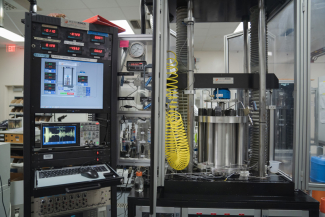
This laboratory is equipped with a customized dual-holder coreflood unit, slim tube apparatus, porosimeter, Anton Paar viscometer, gelation and gelant characterization equipment, high-pressure cell, ovens, Soxhlet extractor, and a full suite of chemistry instruments. The facility is well suited to address challenges related to CCUS/CCS, advanced core analysis, waterflooding, enhanced oil recovery (EOR) methods—including miscible displacement, chemical flooding, and foam flooding—as well as improved oil recovery (IOR) techniques with a focus on conformance control and produced water management.

Modeling and Simulation of Porous Media (MSPM) focuses on characterization, modeling, numerical simulation, optimization, and data analysis for the applications in petroleum engineering and subsurface energy and environmental systems.

We study a wide range of processes in unconventional reservoirs, spanning scales from 10 nm to 1 cm, where subsurface engineering interfaces with nanofluidics and nanomechanics. Our goal is to quantitatively determine how small-scale processes control the large-scale (~ 1 cm) behavior in the subsurface. Our laboratory is designed to conduct high-precision measurements to develop physically representative models. Standard measurements conducted on core plugs or blocks are used to test our results, but they are not the main focus of our research. Current activities include laboratory experiments, theoretical investigations, the development of predictive models, and engineering and scientific applications. Our recent efforts have increasingly focused on the application of deep learning and generative artificial intelligence.

The Plasma Simulation Laboratory features a pulse plasma generation equipment with an output capacity of up to 20kJ of electrical energy connected to a triaxial cell with a monitoring and recording system.

High Pressure High Temperature (HPHT) Advanced Phase Behavior Characterization Interaction of Phase Behavior and Flow (PI: TBD)
  • High Pressure and High Temperature Coreflood System RelPerm with Radioactive Source. Ideal instrument for multiphase multicomponent flow analysis in porous media under extreme conditions and for relative permeability measurements at ultra-high pressures and corrosive environments.
  • High Pressure and High Temperature Magnetic Suspension Balance instrument. Ideal for high end research on various topics, including hydrogen storage, CO2 storage in tight rocks and other porous media, fluid rock interactions, etc.
  • PVT Analysis System: HPHT Full Visibility PVT system, HPHT Capillary Viscometer, High Volume Flash Unit, HPHT Densitometer, Cryogenic Distillation Unit. Ideal for complex fluid characterization under extreme chemical and HPHT conditions.
  • High Pressure and High Temperature Rheometer. Ideal versatile instrument for rheological studies (viscosity, shear rates, elasticity) of liquids pressurized with gases, polymers, drilling fluid, and more, under wide range of conditions.
  • Slim Tube System for High Pressure and High Temperature conditions. Ideal instrument for dynamic miscibility test of the actual flow in porous media under extreme conditions.

The Energy Industry Partnerships (EiP) team is leading the charge to help the University of Houston emerge as the leading energy university by bringing value to the energy industry using smart, innovative and integrated approaches to the recovery of oil and gas through research pertaining to CO2 – EOR conventional & unconventional Reservoirs, waterflooding / IOR – conventional & unconventional reservoirs and integrated reservoir management – conventional & unconventional Reservoirs.

Well Drilling and Completion Flow Loop Laboratory features the Well Drilling & Completion Flow Loop and the Wellbore Production/Injection Flow Loop.